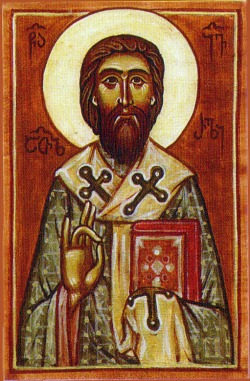
Metropolitan Bishop
He was born around 1650 in the south of Georgia, in the region of Samtskhe. He was baptized in the name of the Apostle Andrew. Together with King Archil, he went to Russia and established a Georgian printing house. He was captured by Dagestani robbers and sold into slavery to the Turks. In Constantinople, he learned many languages. Thanks to Patriarch Dositheus of Jerusalem, he was ransomed from slavery and began to embroider banners and carve wood.
In 1690, at about the age of forty, he was invited to Wallachia by the holy martyr Prince Constantine Brâncoveanu. He took monastic vows under the name Anthim and was ordained a priest. For four years, he managed the Bucharest printing house, then created a new printing press in the Snagov Monastery. After becoming the abbot, he continued his publishing activities. From 1701 to 1705, he again headed the princely printing house. He then became the Bishop of Râmnic, where he opened a printing house and published ten books in three years. In 1708, he became the Metropolitan of Wallachia, opened new printing houses, and published nineteen books.
During his lifetime, he published sixty-four church books in Romanian, Church Slavonic, Turkish, and Arabic, thirty-eight of which he wrote himself. He was a good shepherd, comforting the people with words and acts of mercy. He opened schools for poor children and founded a monastery in honor of All Saints in Bucharest.
In 1716, the Turks accused him of conspiring to join Wallachia to the Austrian Empire. He was deposed, blinded, and exiled to the Sinai Monastery. On the way, he suffered from cruel treatment and was drowned in the Tundzha River.
He can rightly be called a man who renewed the Christian consciousness in the Romanian principalities. Thanks to his initiative, the Romanian language became the official language of worship, which contributed to the enlightenment and unification of the Romanian people.
He was glorified by the Romanian Church in June 1992. The Georgian Church commemorates him on June 13. On March 7, 2018, the name of the holy martyr was included in the calendar of the Russian Orthodox Church.
