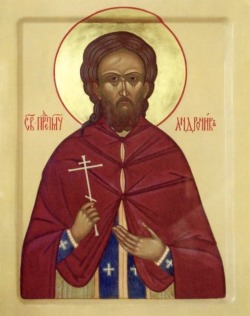
Hieromonk
He was born on October 5, 1885, in the village of Ogryzkovo, Volokolamsk district of the Moscow province, into the family of a peasant, Ivan Surikov, and was baptized with the name Andrei. He received his education at a church parish school. In 1902, he entered the Mozhaisk Luzeck Monastery, where he served in the choir. In 1916, he was drafted to the front and served as a private. In 1918, he was demobilized, returned to the monastery, and was tonsured into monasticism with the name Andronik.
In 1920, he was transferred to the Moscow Simonov Monastery, where on December 20, he was ordained as a hierodeacon. In 1924, he was awarded a double orarion, and in 1928, he was ordained as a hieromonk. After the closure of the Simonov Monastery in 1929, he served in the Assumption Church in Krutitsy until December 28, 1930, when he was arrested for 'active anti-Soviet activities'.
On December 31, 1930, during interrogation, he stated that he had never been a member of political parties and led a secluded life. The OGPU troika sentenced him to three years of exile in the Northern Territory, after which he worked in timber felling in the city of Pinega. In 1934, he returned to his homeland in the village of Ogryzkovo.
On November 27, 1935, Bishop of Volokolamsk Ioann appointed him as a psalmist at the Nikolayev Church in the village of Kholmets. On November 24, 1937, he was arrested on charges of undermining labor discipline and organizing religious discussions. During interrogations, he claimed that he did not engage in anti-Soviet propaganda and did not glorify tsarism.
On December 3, 1937, the NKVD troika sentenced him to ten years of imprisonment in a correctional labor camp. In March 1938, his character references indicated that he considered the persecutions illegal and behaved secretly. On March 31, 1938, the NKVD troika sentenced him to execution. Hieromonk Andronik (Surikov) was shot on September 22, 1938, and buried in a common unmarked grave.
