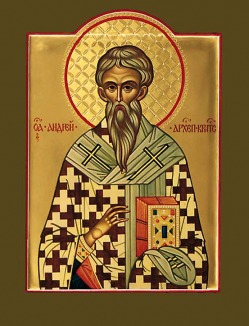
Archbishop
Saint Andrew of Crete was born in Damascus. Until the age of seven, he was unable to speak. However, after receiving the Holy Communion, he was miraculously healed. At the age of fifteen, he traveled to Jerusalem, where he became a reader and lived in the service of the Patriarch Theodore of Jerusalem. He lived a virtuous life, pleasing both God and his fellow men.
At the Sixth Ecumenical Council in Constantinople, convened to address the heresy of the Monophysites, Saint Andrew distinguished himself as an archdeacon through his defense of the Orthodox doctrine. After the council, he remained in the city, where he was ordained a deacon and devoted himself with great zeal to the care of orphans and of those in need.
During the reign of Justinian II, he was appointed Archbishop of Crete. There he became renowned for his teaching, his holiness of life, and his pastoral ministry.
He composed many inspired ecclesiastical works, including the famous Great Canon, which is chanted during the Great Lent.
In 740 AD, while returning by sea from Constantinople, where he had been sent to settle various ecclesiastical matters, the saint reposed peacefully in the Lord. He was buried at Skala Eresou on the island of Lesbos. To this day, a church dedicated to the saint still stands there, while his tomb continues to be venerated by many faithful pilgrims.
