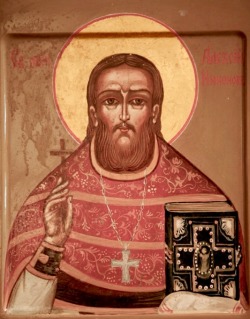
Presbyter
He was born on October 15, 1881, in Moscow. His father, Mikhail Nikонов, worked as a land surveyor. In 1902, he graduated from the Moscow Commercial School and served in the army starting in 1903. In 1905, he left the service and entered the Moscow Theological Academy, which he graduated from in 1910.
From 1911 to 1914, he was a teacher in Dankov, Ryazan Province. With the onset of World War I, he was drafted into the army and served as a warrant officer in the 11th Siberian Rifle Division. In 1917, he was transferred to the 712th regiment, located in the Pinsk Marshes.
From December 1917 to July 1918, he commanded a platoon of the guard company in Dankov and was an assistant military leader. In 1918, he resumed his teaching activities. In 1921, he became a psalmist, and at the end of August 1922, he was ordained as a priest and served in the Assumption Church of the town of Klin in the Moscow region.
In May 1922, the Renovationist schism arose. Priest Alexey Nikонов, along with Priest Alexey Vorobyov, was arrested on September 26, 1924, on charges of organizing an illegal gathering of believers. On October 2, 1924, the relatives of the arrested brought a parcel with a note.
On October 16, Priest Alexey Nikонов was summoned for interrogation, where he denied participation in the illegal gathering. As his guilt could not be proven, he remained in Butyrka prison for several months. On February 27, 1925, he was sentenced to exile in the Naryn region for two years.
After serving his sentence, he was prohibited from residing in six major regions of the country. He settled in the village of Spas-Doshchaty and began serving in the Transfiguration Church, proving himself to be a devoted shepherd of the Church of Christ.
In February 1930, he was arrested on charges of anti-Soviet activities and imprisoned in the Zaraysk administrative department. On February 10, he was interrogated, and he stated that he had not acted against the Soviet government. Based on witness testimonies, an indictment was drawn up.
On January 20, 1937, the Special Meeting of the NKVD sentenced him to imprisonment in a correctional labor camp for five years. He was sent to Sevzheldorlag and died on October 29, 1938. His body was buried in the cemetery of the village of Kiltovo in the Knyazhpogostsky district of the Komi Republic.
