To the Church of Panagia Faneromeni
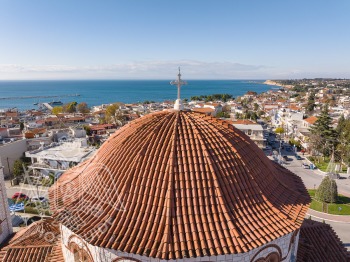
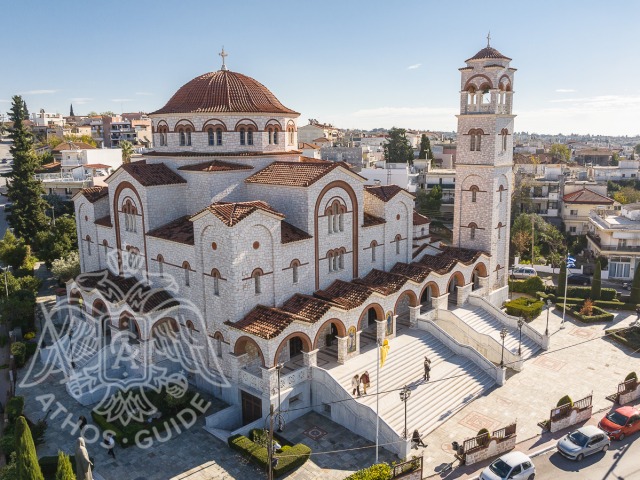
The majestic Church of Panagia "Faneromeni" (The Revealed Mother of God) was built in 1984. It owes its foundation to Fr. Prokopios, the first Metropolitan of the Metropolis of Nea Krini, which includes the settlement of Nea Michaniona where the church is located.
The church is dedicated to the icon of Panagia "Faneromeni," which was brought here in the 1920s when a significant number of Greeks were forcibly expelled from their homeland on the Kapidag Peninsula (territory of Turkey). Leaving their homeland, despite the pressure of circumstances, hardships, and anxieties, the pious refugees took with them their Protectress—the miraculous icon of "Panagia Faneromeni"—and brought it to Greece. Despite the suffering and deprivation of those difficult years, they erected a small basilica in Nea Michaniona (that is, New Michaniona), where they placed their icon. Yet their heartfelt desire was to one day be deemed worthy of the honor of placing it in a cathedral worthy of its greatness.
Years after the construction of the basilica, the territory of Nea Michaniona became part of the new Metropolis of Nea Krini, formed as a result of its separation from the Metropolis of Thessaloniki. Its first shepherd, Metropolitan Prokopios, made a pilgrimage to the humble basilica of Panagia Faneromeni and was so deeply impressed by the icon that he set himself the goal of overseeing the erection of a majestic church in its honor. The Metropolitan fulfilled this vow, and on March 9, 1975, the cornerstone of the new church was laid. Exactly nine years later, on May 27, 1984, the consecration of the magnificent new Byzantine-style church took place.
The church has five side chapels dedicated to Saint John the Theologian, the Holy Great Martyr Prokopios, the Honorable Forerunner, the Prophet Moses, and Saint Anne. The Divine Liturgy and a prayer service to the Most Holy Mother of God are celebrated here daily.

To Panagia Faneromeni Icon
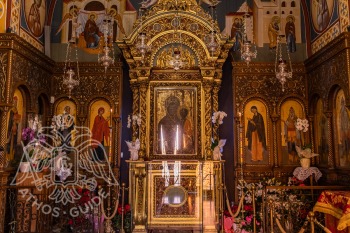
On the Kapidag Peninsula, from where the icon was brought, there existed two holy images of the Mother of God with the name "Faneromeni" (The Revealed One). Christians called them "sisters": one was known simply as "Faneromeni," and the other, kept in the settlement of Michaniona, as "Panagia the Great." After the Asia Minor Catastrophe, the former was transferred to Constantinople and handed over to the Ecumenical Patriarchate. Today it is kept in the Church of Saint George. As for the latter, the Greeks of Michaniona took it with them when they were expelled from their homeland, for the icon was considered their patroness and protectress.
Years have passed, and today the miraculous image of Panagia Faneromeni adorns the main church of the settlement of Nea Michaniona (Νέα — New). The fame of the icon has spread throughout Greece and even beyond its borders. A great multitude of Christians, humble pilgrims, and worshippers, come to bow before its grace, especially on the Feast of the Dormition of the Mother of God and on the days dedicated to the veneration of the icon (August 22–23).
A prayer service is celebrated daily before the holy icon, during which names for health are read. People from all over the world facing health problems send their names for commemoration, so that the Mother of God may become their helper and intercessor.
What do we pray the Mother of God "Faneromeni" for?
The miracles of the icon are innumerable. Mothers who have no children, after prayer and supplication to Panagia Faneromeni, receive from her the gift of childbearing. People with health problems find healing. It is believed that the icon fulfills only those requests of people that serve for the benefit of their souls.