The republic of Mount Athos, located on the peninsula of Athos in Chalkidiki, is a self-governed monastic state with its own laws and a unique way of life for its residents. A visit to this sacred monastic community is undoubtedly a unique and spiritually enriching experience. However, organizing such a trip can be complex and demanding. Both entering Mount Athos and visiting its holy monasteries require careful preparation and prior arrangements in order to ensure a safe and trouble-free stay.
.jpg) For those seeking professional assistance and a guided experience, there are fully organized pilgrimage tours available. However, if you prefer to plan your trip on your own, here's a detailed guide outlining all the necessary procedures, key information, and important things to consider.
For those seeking professional assistance and a guided experience, there are fully organized pilgrimage tours available. However, if you prefer to plan your trip on your own, here's a detailed guide outlining all the necessary procedures, key information, and important things to consider.
1. From Thessaloniki to Ouranoupoli
1.1 Arrival in Thessaloniki
Thessaloniki is the closest major city to Mount Athos, which is why it is the main gateway for travelers heading to the peninsula. If you're travelling from abroad or from remote parts of Greece, you'll first need to make your way to Thessaloniki. The city can be reached by plane, train, or intercity bus (KTEL).
1.2 Getting to the Port of Ouranoupoli
Once you arrive in Thessaloniki, you’ll need to arrange your transportation to the port of Ouranoupoli, which is where the ferries to Mount Athos depart from.
There are three main options. The most economical choice is the intercity bus (KTEL). Buses to Ouranoupoli depart from KTEL Chalkidikis. The journey takes around 2.5 hours. Bear in mind that the bus station is located on the eastern edge of Thessaloniki, a few kilometers from the ring road, and about 10 km away from the airport. So, you will need to take additional transport, such as a taxi or local bus, to reach the station.
Taking a taxi straight to Ouranoupoli from wherever you arrive in Thessaloniki (the airport, the train station, or the city center) would be a more convenient, comfortable, and direct option. Though, while significantly faster and easier, it is also considerably more expensive.
Finally, you can book a transfer from Thessaloniki to Ouranoupoli. If choosing this option, all you need to do is to make a booking in advance, and a professional driver will meet you at a chosen arrival point in Thessaloniki (be it the airport, the train station, or any other location). They will take you to the port of Ouranoupoli in a comfortable vehicle tailored to your needs (e.g., if you're traveling with young children or require extra space).
To sum up, the transport options from Thessaloniki to Ouranoupoli are as follows:
- Intercity bus from the KTEL Chalkidikis bus station
- Taxi from your arrival point in Thessaloniki
- Private transfer with a vehicle of your choice
2. Visa to Athos (Diamonitirion)
Before entering Mount Athos, you must obtain a special entry and residence permit, a visa known as the "Diamonitirion." This official document, issued by the Athonite authorities, is your sole form of identification while visiting the monastic state. No other ID is valid within Mount Athos territory.
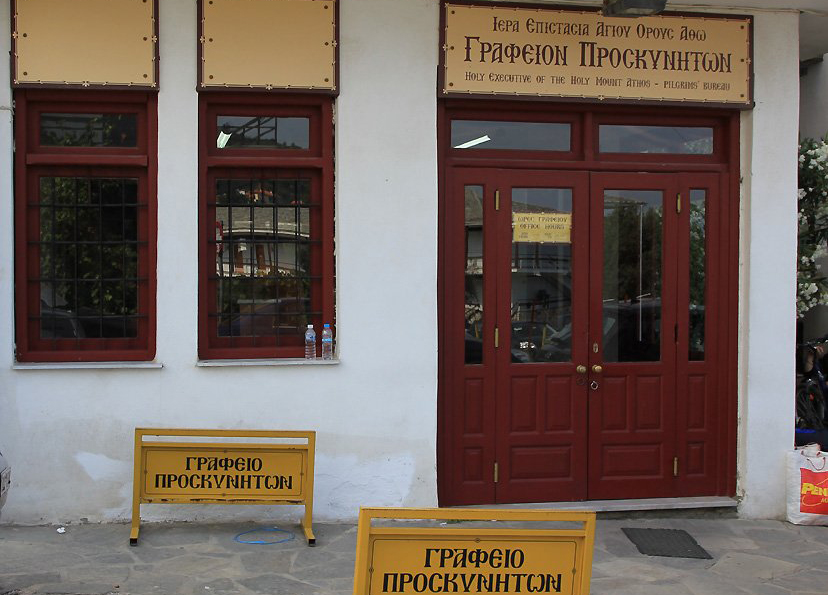
The Diamonitirion is issued by the Pilgrims' Office in Ouranoupoli, following a formal request. The office provides services in both Greek and English. Due to limited daily entry slots and high demand, particularly during religious holidays or peak seasons, it is recommended that you apply at least 4–5 months in advance.
.jpg)
Alternatively, Athos.Guide offers assistance with the acquisition of Diamonitirion. Visit the relevant page for further information, and in order to submit an application for obtaining Athos visa. Owing to our longstanding collaboration, the Diamonitirion application process can be significantly faster.
Key points:
- The application for the Diamonitirion is submitted through the Pilgrims’ Office in Ouranoupoli
- Early reservations (4–5 months ahead) are essential, especially during busy periods.
- An English-language service is available for international visitors
- Obtaining Diamonitirion with Athos.Guide ensures a more efficient and fast application process
3. From the Port of Ouranoupoli to the Shores of Mount Athos
3.1 Ferries, Schedules, and Destinations
Once you arrive at the port of Ouranoupoli and receive your Diamonitirion, the next step is to get your ticket to a ferry heading to the ports of Mount Athos. It’s important to note that ferry services to and from Mount Athos are operated by two different ferry companies, each serving different routes:
- Agioreitikes Grammes: Primarily operates ferries to the main port of Daphne, which is the central point for reaching some of the larger monasteries on the peninsula
- Mikroathos N.E.: Operates ferries to the smaller ports, serving some of the more remote monasteries and sketes along the shores of Mount Athos
.jpg)
Attention! It is essential to book your ferry tickets in advance, particularly during the peak holiday season which lasts from April to October, when there is high demand. Without a reservation, you may not be able to board due to limited availability.
Unfortunately, neither of the ferry companies offers an online booking option. However, you can reserve your tickets by calling the ferry companies directly. English-speaking services are also available for international travelers.
To sum up:
- Communication with Mount Athos is carried out by ferry boats
- Online booking of the ferry tickets is not available
- Book the tickets by phone, particularly during busy periods (April–October and major holidays)
- Find detailed timetables and contact information here
4. Transport and Accommodation in the Monasteries of Mount Athos
4.1 Preparation
Careful planning is essential to ensure a smooth and enriching stay in Mount Athos. The first step is to decide in advance upon the monasteries you intend to stay overnight. You should also confirm that your chosen route and timetable are feasible, ensuring that it is possible to travel between the monasteries within the time you have..jpg)
Mount Athos is a land rich in history and spiritual significance, offering a variety of destinations and points of interest. To make the most of your visit, it's important to prioritize your expectations and avoid getting caught up in small details.
Things to consider:
- Decide on your route and the monasteries you want to visit
- Plan your mode of transportation around the peninsula (on foot or by vehicle)
- Secure overnight stays at the monasteries in advance
Attention! Private vehicles are not allowed within Mount Athos. If you are traveling with your own vehicle, you must leave it in designated areas outside the peninsula before entering the monastic state.
4.2 Getting Around on Foot
If you decide to explore Mount Athos on foot, it is essential to have the proper maps or an experienced guide. The paths in Athos can be rough, and many routes are physically demanding. It's important to consider factors such as distances, weather conditions, and the length of daylight in order to ensure you don’t find yourself locked outside the monasteries after dark.
To make your planning easier, consult the route duration table available in the relevant section of our website.jpg)
Hiking Mount Athos requires:
- Proper organization and preparation
- Thorough map of the peninsula
- Physical fitness
4.3 Travel by Vehicle
Since private vehicles are not permitted within Mount Athos, you will need to make alternative arrangements for transportation. If unable or unwilling to travel on foot, you have several options:
- Buses: There are buses that operate between the port of Daphne and Karyes, as well as to the Holy Monastery of Iviron. Additionally, smaller buses run from Karyes to various monasteries, covering short distances where there is road access. While bus travel is the most straightforward option, the increased number of pilgrims in recent years has placed significant strain on the Athos road network, leading to overcrowding and delays. Therefore, if you choose to travel by bus, be sure to allow plenty of time for potential flexibility in your itinerary.
- Animal transport: For areas inaccessible by vehicles, you may be able to arrange for animal transport (donkey or mule) to assist your journey
- 4x4 vehicles: For a more comfortable transportation, you may book 4x4 jeeps suitable for groups of 4-7 people, which operate within Mount Athos with the permission of the monks
.jpg)
To sum up, you can travel within Mount Athos:
- On foot
- By bus
- By animal (donkey/mule)
- By 4x4 vehicles
4.4 Accommodation in the Monasteries
Before embarking on your trip to Mount Athos, it is essential to arrange your accommodation in the monasteries in advance. Due to the large number of pilgrims, especially at peak times, it's important to email the monasteries well in advance and make sure you receive a confirmation of your stay in time for your trip.
- Contact the monasteries well in advance to secure your overnight stays
- Once emailed the monasteries, make sure you have received a positive response
- Find the contact details of the monasteries here
4.5 Climbing the Top of Mount Athos
Climbing the peak of Mount Athos requires additional preparation and equipment. First of all, keep in mind that:
- Climbing the peak is only allowed during the summer months, and only if weather conditions permit.
.jpg)
- In winter, climbing is strictly prohibited for safety reasons.
In case your pilgrimage includes climbing Mount Athos, sturdy hiking boots and comfortable clothing are highly recommended. If you plan to ascend and descend within one day, make sure you have with you:
- Drinking water
- Light yet nutritious snacks (e.g., nuts, dried fruit, energy bars, chocolate)
- Gas burner to prepare hot beverages
If you plan to spend the night in a shelter at the top of Mount Athos, you should also bring:
- Headlamp (your hands must be free when climbing)
- Sleeping bag
- Sleeping pad
- Lunch and breakfast (one that does not require cooking, e.g. canned food)
- Hygiene kit
- It is advisable to bring insect repellent
- If desired, you can also bring trekking poles
.jpg)
If necessary, some of the equipment can be purchased in Ouranoupoli before entering the monastic republic.
For more detailed information about climbing the top of Mount Athos, please consult the relevant page and prepare yourself accordingly.
5. Rules of Conduct
Mount Athos is first and foremost a place of worship. While many visitors come to the Holy Mountain not only to visit monasteries, but also to admire the beauty of the landscape, learn about the unique structure of the Athonite state and the daily life of the monks, it is important to remember that everyone must abide by the rules established by the Athonite community. Among the key rules are those concerning dress code, ensuring that visitors show the necessary respect for the sanctity of the place.
Find detailed regulations here
6. Women and Mount Athos
Although women are not allowed to enter the monastic community, there are cruise tours along Athos shores that allow them to admire the coastal beauty of the Athonite peninsula and experience the spirituality of the place. .jpg) Some of these cruises have a special significance, as the monks of Mount Athos bring miraculous icons and holy relics aboard the ships, so that those unable to visit the interior of Athos can still receive the grace of its sacred heritage.
Some of these cruises have a special significance, as the monks of Mount Athos bring miraculous icons and holy relics aboard the ships, so that those unable to visit the interior of Athos can still receive the grace of its sacred heritage.
Visit for more details
To conclude
Mount Athos is not just a tourist destination. It is a deeply spiritual place, a land of prayer and devotion. When planning your trip, take the time to carefully consider the details of your journey.
Remember to focus on the spiritual experience that Mount Athos offers. Aim to create the conditions allowing for you to leave behind all worldly distractions and embrace the tranquility and sacred atmosphere of the peninsula.