On July 3, 1937, Stalin ordered the accounting of all kulaks who had returned to their homeland, with the aim of immediate arrest and execution of the most hostile among them. In this context, the priest Andrei Bystrikov and the peasant Vasily Vinogradov were arrested, accused of counter-revolutionary activities.
Priest Andrei was born in 1873 in the village of Zalesye, Pechersk volost, Pskov district, in the family of a priest. He graduated from the Pskov Teacher's Seminary, was ordained as a deacon and then as a priest. In 1930, he was arrested and sentenced to two years of imprisonment and five years of exile to the Urals. He returned home in 1935.
After his arrest, the investigation interrogated the priest, who denied his guilt, asserting that he did not engage in counter-revolutionary agitation. Similarly, peasant Vasily, born in 1891, also denied his guilt, stating that he did not conduct any agitation.
During the investigation, other peasants were interrogated, such as Semyon Nikandrov, Sergey Mikhailov, and Spiridon Saveliev, who also did not confess to any wrongdoing. All of them were arrested and imprisoned in the Toropets prison.
On September 20, 1937, the assistant to the operative officer of the UGB drafted an indictment, and on October 3, the NKVD Troika sentenced priest Andrei Bystrikov and laymen Vasily Vinogradov, Sergey Mikhailov, and Spiridon Saveliev to execution. They were shot on October 7, 1937.
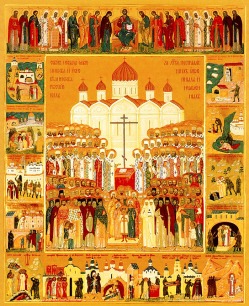
They were canonized among the ranks of the New Martyrs and Confessors of Russia at the Jubilee Archpastoral Council of the Russian Orthodox Church in August 2000 for public veneration.
