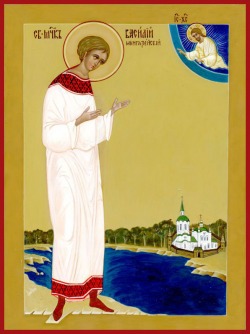
Saint Basil the Righteous Martyr of Mangazeya, born around 1583 in Yaroslavl, was taken to work by a wealthy merchant in Mangazeya, where he diligently fulfilled his duties. His meekness and humility attracted the goodwill of those around him. In his youth, he often prayed in church, which caused confusion for his master when he accused him of complicity in theft. Saint Basil, remaining innocent, endured torture and was killed around 1600–1602. His body was placed in a coffin and buried.
Forty-seven years later, in 1649, his coffin was discovered, and healings began associated with his name. Many were healed, coming to his prayerful intercession. In 1653, his name was revealed to the hunter Grigory Karataev, and in 1659, the tomb was opened with the witnessing of the relics. In 1670, the relics were transferred to Turukhansk, where the veneration of Saint Basil increased.
In 1719, Metropolitan Philotheus transferred the relics to a new church, and in 1788, the coffin appeared again. The veneration of Saint Basil did not cease, and he became the patron of hunters. In 1802–1803, during an epidemic, the residents of Turukhansk associated the calamity with the absence of veneration for the saint. In 1907, his image was printed, and in icons, he is depicted as a young man with light hair, praying.
