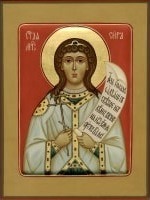
The Virgin Martyr Syra lived during the 6th century in Persia. She was the daughter of a pagan priest who worshipped fire, following the religion of Zoroastrianism. After the death of her mother, her father, wishing to keep her away from Christianity, sent her to Tarsus and entrusted her to a priestess so that she might also be trained in the priestly practices of their religion.
The saint grew up and indeed served the pagan faith of her father. However, when she once encountered Christian beggars, she recognized the grace of the true God and came to believe in Him. From that moment, she began to live as a Christian, studying the Scriptures, reading the Psalms, and praying.
At one point she fell gravely ill and sought help at a Christian church. There, the priest drove her away, knowing of her connection with idolatry. Nevertheless, the saint was healed after touching his vestments.
Her relatives soon began to suspect her intentions. Her stepmother, pretending to be a Christian, tried to make her change her mind. Yet a divine vision that the saint received kept her firmly devoted to Christ. She then decided to be baptized. The bishop, fearing the reaction of her family, postponed the baptism and advised her first to confess her faith openly to her relatives.
During a pagan ceremony, the saint scattered the sacred ashes of fire—revered in their religion—upon the ground and publicly proclaimed her faith in Christ. When her father learned of this act, which he considered sacrilegious, he subjected her to severe tortures.
After many sufferings, she was handed over to the chief priest and to King Khosrow the Elder. While in prison, she kept her faith strong and unshaken. There she received baptism and was granted the gift of working miracles.
In the end, she was condemned to death by strangulation. Her execution was carried out with great cruelty. Her body was thrown to the dogs, but the animals approached it with reverence. Faithful Christians later retrieved her relics and buried them with honor († 558).
The Church celebrates her memory on August 24.
