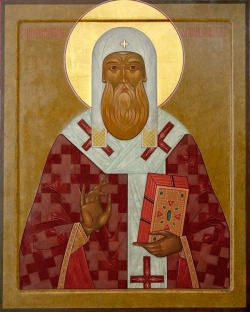
Archbishop
He was born in the village of Pekhorka near Moscow, seeking solitude. By the will of his parents, he entered into marriage, accepted the priesthood, but soon became a widower and took monastic vows in the Dubensky Uspensky Monastery. He was elected the igumen of the monastery, which later became known by his name – the Serafionova Desert.
Desiring stricter asceticism, he became the abbot and moved to the Trinity-Sergius Lavra, where in 1495 he became the igumen. He was respected by Grand Duke Ivan Vasilyevich, who, at his request, pardoned three noblewomen sentenced to death.
At the Council of 1504, he ardently defended church and monastery properties as a means of charity. In 1506, he was consecrated as the Archbishop of Novgorod. During a great fire in Novgorod in 1508, with his tearful prayers, he implored the Lord to cease it.
He endured many hardships: in 1509, he was deprived of his see and exiled to the Andronikov Monastery in Moscow. In 1511, he moved to the Trinity-Sergius Lavra, where he spent his last years in constant contemplation and prayer, having been granted by the Lord the gift of foresight and miracle-working.
Having accepted the schema, he peacefully reposed on March 16, 1516. His incorrupt relics were discovered on April 7, 1517, and rest beneath the ground in the Serafionova Chamber at the Trinity Cathedral in the Trinity-Sergius Lavra.
The Lord glorified His servant with the gift of miracle-working both during his life and after his death: once on the feast of the Dormition, he healed a lame man who had crawled on his hands and feet for many years, relying on wooden sticks.
In 1608, during the siege of the Lavra by the Poles, many monks and laypeople saw him in episcopal vestments, coming to the church to pray for his monastery.
