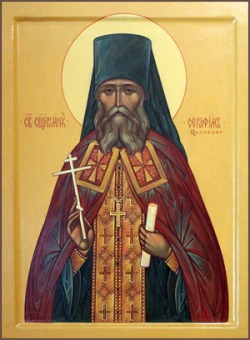
Archimandrite
Saint Seraphim was born in 1877 in the town of Buzuluk, in the Samara Governorate, into the family of a craftsman, Prokopy Shchelokov. After completing the primary school, he entered the Holy Elizarov Monastery in the Pskov Governorate, where he became a monk and received the name Seraphim. In 1909, he was ordained a hieromonk.
In 1917, he moved to the Holy Monastery of the Mother of God in the Kazan Governorate, where he remained until the hermitage was closed in 1928. He was then summoned to Moscow to serve at the Holy Danilov Monastery, where, in 1930, he began serving as acting abbot. That same year, the monastery was closed, and Father Seraphim began serving at the Church of the Resurrection.
In 1931, the communist authorities launched a large-scale campaign of persecution against the clergy. Father Seraphim was arrested on 15 April, detained in Butyrka Prison, and interrogated. He nevertheless refused to cooperate with the authorities. Ten days later, the investigation was completed, and the saint was found guilty of anti-Soviet activities. On 30 April 1931, he was sentenced to three years of exile and sent to Ust-Kulom in the Komi region.
After returning from exile, he settled in the town of Kashira, in the Moscow Governorate, where he began serving at the town’s cathedral. He was soon elevated to the rank of archimandrite. On 10 September 1937, he was arrested and detained in Kashira Prison. On 19 October, an NKVD troika sentenced him to death.
Archimandrite Seraphim (Shchelokov) was executed on 21 October 1937 and buried in an unmarked mass grave at the Butovo Firing Range near Moscow.
