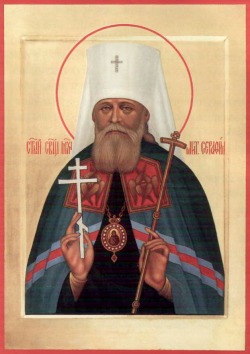
Metropolitan Bishop
Saint Seraphim Chichagov (born Leonid Mikhailovich Chichagov) was born on January 9, 1856, in Saint Petersburg into the family of an artillery general. He was baptized in the church dedicated to Saint Alexander Nevsky. His service to God began during his military career, when he displayed remarkable bravery while fighting in the Russo-Turkish War (1877–1878).
After the war ended in 1878, he met Saint John of Kronstadt, who became his spiritual father and guide. In 1879, he married Natalia Nikolaevna Dokhturova, with whom he raised four daughters. Having acquired medical knowledge, he developed a therapeutic method based on herbal remedies, which he later described in his work Medical Conversations.
In 1890, he left the military and moved to Moscow in preparation for the priesthood. On February 26, 1893, he was ordained a deacon, while two days later he became a priest. This period was marked by the death of his wife. In 1895, she was buried in Diveyevo Monastery.
From 1896 onward, he served in Moscow. In 1898, he became a monk and received the name Seraphim. The following year, he was appointed abbot of the Spaso-Euphrosyne Monastery. In 1902, he republished the Chronicle of the Diveyevo Monastery, an important work that contributed significantly to the canonization of Saint Seraphim of Sarov.
On April 28, 1905, he was consecrated Bishop of Sukhumi. His ministry coincided with the outbreak of revolutionary unrest, during which he actively defended the Orthodox faith. In 1906, he was appointed to the Diocese of Oryol, and in 1908 to the Diocese of Chișinău, where his great work earned widespread respect and recognition.
In 1912, he became Archbishop of Tver and Kashin. During World War I, he offered strong support to both the clergy and all faithful Christians. After the Russian Revolution of 1917, he was exiled from Tver and assigned to the Metropolitan See of Warsaw. However, the civil war prevented him from traveling there.
In 1921, he was arrested and exiled to Arkhangelsk. After returning to Moscow in 1924, he was arrested once again, but was released following the intervention of Patriarch Tikhon of Moscow. In 1933, he retired.
In 1937, during the Soviet persecutions, he was arrested and executed on December 11 of that same year.
