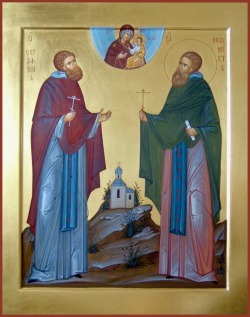
Hieromonks
In order to spread the Orthodox faith in the Turkestan region and to spiritually enlighten the Asian nomads, His Grace Bishop Alexander (Kulchitsky) consecrated a site for the establishment of the male Holy Trinity Missionary Monastery on the shores of Lake Issyk-Kul in 1882. The first inhabitants of the monastery faced difficulties, including attacks from nomadic tribes. In 1886, 11 monks arrived at the monastery from the Holy Mikhailovskaya Zakuabnaya Desert, and in 1894, eight monks led by Igumen Sebastian arrived from Valaam Island.
In the early 20th century, several monks from the Nativity of the Mother of God Glinskaya Desert were invited to the monastery, among whom were monks Seraphim, Theognost, and Anatoly, known for their education and high ascetic life. Father Seraphim possessed iconographic talent, while Father Theognost had good administrative skills.
By 1909, monks Seraphim and Anatoly were called to the cathedral city of Verny, where they served in the Assumption Church. In 1916, Hieromonk Anatoly managed the archbishop's choir in the Ascension Cathedral of the city of Verny. After the Bolsheviks came to power in March 1918, the monks went into the mountains and established a skete on Mount Mohnataya. Hieromonk Seraphim arranged a church in it, hewn into the mountainside.
In 1921, Hieromonk Seraphim was killed by Red Army soldiers, and Hieromonk Theognost also became a victim of violence. The monks were buried without coffins, wrapped in a mantle. Hieromonk Anatoly continued to serve in Verny but was soon arrested and shot.
The grave of the holy martyrs Seraphim and Theognost in Aksai was venerated by the faithful. In 1991, a cross was erected on it, and in 2000, they were canonized among the saints of the New Martyrs and Confessors of Russia for church-wide veneration.
