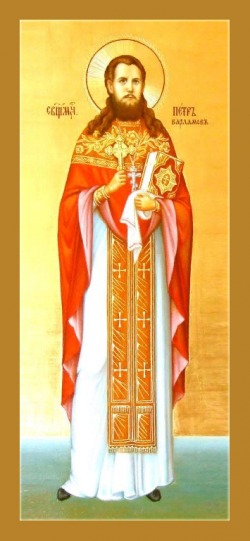
Presbyter
Saint Peter was born in 1897 in the village of Dyasevo, in the Belebeevsky District of Ufa. He lost his father at the age of nine. His mother raised on her own three sons and a daughter. Peter graduated from a rural school, became a chanter and a deacon. After completing his studies, he was appointed at the Church of the Icon of the Mother of God in the village of Preobrazhenskoye.
During the Russian Civil War, the saint protected and saved many people from death. In 1919, at the request of his parishioners, he was ordained a priest. Father Peter carried out his pastoral duties with zeal, preaching and serving his flock while surviving through agricultural work.
In 1927, members of the local Communist Youth League set fire to his home, leaving him and his family homeless. He then turned to the villagers and asked for their help. The local farmers provided him with land on which to build a new home. In 1929, persecution of the Church intensified and the parish church was closed. The holy New Martyr urged his parishioners to stand firm in defence of their faith. On 26 May 1929, he was arrested.
Following his arrest, his parishioners gathered to prepare a letter in his defence. However, despite their efforts, the saint was charged with counter-revolutionary activity. On 9 March 1930, he was sentenced to death. He was executed on 11 March 1930 and buried in an unmarked grave.
His wife, Anna Ivanovna, prayed for him until the end of her life, giving thanks to the Lord for all that they had experienced together.
