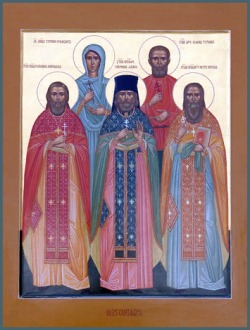
Saint Peter was born on June 24, 1880, in the village of Vyshgorod, Vereysky district of Moscow province, in the family of peasant Alexey Yurkov. After finishing the village school, he began to manage his peasant household. In 1915, he was drafted into the army and served until 1917. After demobilization, he settled in Moscow, worked as an accountant, but his main focus remained singing in the church choir. In 1926, he was ordained as a deacon, and then as a priest, and transferred to the Assumption Church in the village of Simbukhovo. During this time, the persecution of the Russian Orthodox Church intensified, and he and his wife lived in Simbukhovo, leaving their older children in Vyshgorod.
Martyr Simeon was born on February 1, 1870, in the village of Simbukhovo, Vereysky district of Moscow province, in the family of peasant Yakov Turkin. After finishing the village school, he served in the army as a non-commissioned officer. In 1918, he witnessed the uprising of peasants in the Vereysky district. Upon learning of the uprising, he tried to persuade the peasants to disperse, but was arrested and sent to Vereya. In the 1920s, he organized a construction cooperative. In 1933, he was elected as the starosta (warden) of the Assumption Church in Simbukhovo.
On September 8, 1937, Priest Peter Yurkov and starosta Simeon Turkin were arrested and imprisoned in a prison in Mozhaisk. They were accused of anti-Soviet activities, but they denied all charges. On September 22, the NKVD troika sentenced them to execution. On September 23, 1937, they were shot and buried in an unknown common grave at the Butovo shooting range near Moscow.
