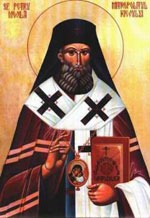
Metropolitan Bishop
He was born on December 21, 1596, in Suceava to the family of Moldavian boyars Mogila. At baptism, he was named in honor of Saint Peter of Moscow. His father, Simeon Mogila, was the hospodar of Wallachia and Moldavia. In 1612, the family was forced to flee to Poland. He received his education at the Lviv Brotherhood School and then continued at universities in Europe, particularly in Paris.
He served in the Polish army, distinguished himself in the battle of Chocim, but soon decided to leave military service and took holy orders. Around 1624, he entered the Kyiv-Pechersk Lavra, where he completed his education and actively participated in the life of the Orthodox monks.
In 1627, he was elected archimandrite of the Lavra. Under his leadership, the Church of the Assumption of the Blessed Virgin Mary was renovated, and the Holoseievskyi Desert was founded. In 1628, the condemnation of the 'Apology' of Meletius Smotrytsky took place.
In 1632, after the election of King Władysław, he was appointed Metropolitan of Kyiv and Halych. During his tenure, the existence of the Orthodox Kyiv Metropolis and four dioceses was legalized. He actively contributed to the establishment of the Kyiv Collegium, which became the first higher educational institution in the East Slavic lands.
He restored several ancient shrines, including St. Sophia Cathedral and the Vydubychi Monastery. He was engaged in publishing church books, demanding their compliance with Greek originals. He introduced new prayers and liturgical sequences and also contributed to the canonization of saints.
He passed away on December 31, 1646, and was buried in the Kyiv-Pechersk Lavra. His body rested at the burial site until World War II, when the coffin with his remains was destroyed. In 1982, silver plates with the family coat of arms and an epitaph were found.
