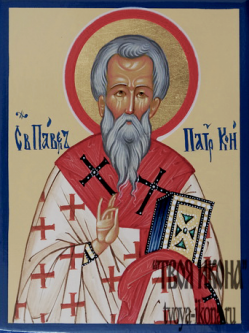
During the reign of Emperor Constantius, the son of Constantine the Great, Orthodox Christians were persecuted by the heretics - Arians. Saint Alexander, the Patriarch of Constantinople, before his death pointed to the presbyter Paul and the deacon Macedonius as worthy pastors. The Orthodox chose Paul, but the emperor, returning from Antioch, deposed him and appointed the Arian Eusebius. Saint Paul went to Rome, where he found Saint Athanasius and other bishops exiled by Eusebius. Pope Julius supported them and wrote to the Eastern bishops to accept them back. However, after Paul's return to Constantinople, the emperor again exiled him and established Macedonius.
In Constantinople, clashes occurred between the Orthodox and the Arians, leading to a large number of casualties. Emperor Constantius, learning of the rebellion, came to the city and again exiled Paul. Saint Paul went to Rome, where Emperor Constans and Pope Julius wrote to Constantius, urging him to return Paul. Constantius, fearing his brother's wrath, restored Paul to the patriarchal throne.
However, after the death of Constans, the Arians began their persecutions again. Saint Paul was exiled to Cucusus, where he was killed by Arians during the Divine Liturgy. Macedonius again became patriarch and continued to persecute the Orthodox. His cruelties caused much suffering among the believers.
The Arian heresies continued to exist until the reign of Emperor Theodosius, who convened a council in Constantinople that condemned these heresies. The emperor honorably transferred the relics of Saint Paul from Cucusus to Constantinople, giving glory to the Father, the Son, and the Holy Spirit.
