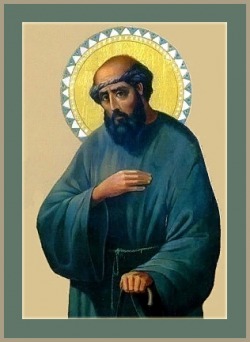
Fool for Christ
Saint Paisius, the Fool for Christ, was born on 8 July 1821 in Lubny, in Poltava Governorate. He came from a large and wealthy family. His mother was deeply devoted to the faith and exceptionally pious. She raised her children in the fear of God and devotion to the Church.
At the age of ten, the saint was sent to the Kiev-Podolia Theological School, while he frequently visited the Kiev-Pechersk Lavra. At sixteen, he remained there and began his first period of spiritual formation. After experiencing a vision of the Virgin Mary, he settled permanently at the monastery as a novice. Venerable Parthenius became his spiritual father.
The saint gradually began to behave strangely in church. He had begun to lose his mind out of love for Christ and through the Divine Grace that filled him with longing for the Lord. As the other monks were unable to understand his behaviour, they relieved him of his duties as a chanter. In time, the saint left the brotherhood and settled in the Goloseev Hermitage. In 1854, he formally received the monastic tonsure and was given the name Paisius.
He then returned to the Kiev-Pechersk Lavra, where he began a life of strict asceticism. He wandered through the city and often spent the night in the streets. He was always poorly dressed and endured the mockery and humiliation of people. However, he always forgave them and prayed for their salvation. For his humility and ascetic struggle, the Lord glorified him with the gifts of miracles and healing.
In 1879, he was admitted to the brotherhood’s almshouse at Kitaev. Despite his own hardships, he continued to care for his weaker brothers. Foreseeing his death, he went to the Lavra, where he reposed on 17 April 1893, after receiving the Holy Communion.
He was buried in the brotherhood’s cemetery at the Monastery of the Transfiguration. The people of Kiev deeply mourned the saint’s repose. In 1999, he was glorified by decision of the Holy Synod of the Ukrainian Orthodox Church, while on 30 November 2017, the Council of Bishops of the Russian Orthodox Church formally approved his canonization.
