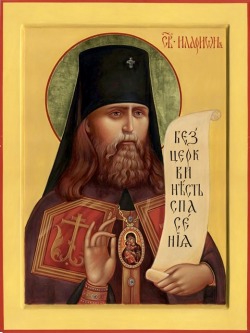
Archbishop
Archbishop Hilarion of Vereya (Vladimir Alexeyevich Troitsky), was born on September 13 in 1886 into the family of a priest, in the village of Lipitsy, in the Tula province. From an early age, he expressed his love of learning. He graduated from the Theological School and later from the Moscow Theological Academy.
On 28 March 1913, he was tonsured a monk and received the name Hilarion, while on 2 June of the same year he was ordained a hieromonk. In 1913, he was appointed inspector of the Moscow Theological Academy. He later became professor of the Holy Scripture and the New Testament. His writings enriched the field of theological studies, while his teachings called the faithful to have spiritual faith and love for Christ.
During the Local Council of 1917–1918, he spoke in support of restoring the Patriarchate, arguing that the Russian Church needed a Patriarch and a spiritual head. Following the rise of the Bolsheviks, he was arrested in March 1919 and spent three months in prison.
On 11/24 May 1920, he was consecrated Bishop of Vereya. Shortly thereafter, he was sent in exile. After his return, Patriarch Tikhon drew close to him and appointed him Archbishop. His activities reflected his resistance to the revolutionary ideas. He sought to restore the ecclesiastical order while remaining in continuous negotiations with the authorities in an effort to secure proper conditions for the life of the Russian Orthodox Church.
In December 1923, he was sentenced to three years of imprisonment and sent to a forced labour camp. During this time, he preserved his inner purity and patience, demonstrating humility and compassion. His martyrdom was completed on 15/28 December 1929, when he died of typhus in the prison hospital.
He was buried in the cemetery of the Monastery of the Resurrection of Christ in Saint Petersburg. His death constituted a great loss for the Russian Orthodox Church.
