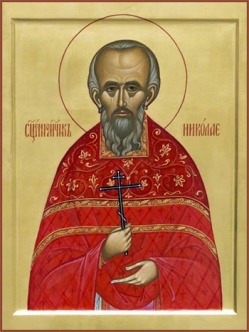
Presbyter
Saint Nicholas was born on March 20, 1877, in the village of Andreevskoye, Ruza district of the Moscow province, in the family of a boatman, Alexander Sokolov. In 1892, he entered the Moscow Theological Seminary, and upon graduation in 1898, he was appointed as a teacher at the parish school in the village of Krymskoye. On September 2, 1899, he was ordained as a priest at the Transfiguration Church in the village of Krymskoye and became the head of the Krymskoye parish school. From 1902 to 1909, he served as a law expert in the Yakshinskaya zemstvo school, and then taught the Law of God at the zemstvo school in the village of Naro-Osanovo. From 1909 to 1915, he was a member of the Ruza branch of the Diocesan Educational Council and was elected to the board of the Zvenigorod Theological School. During his service, he was awarded many church honors, was elevated to the rank of protodeacon in 1924, and in 1931 was awarded a mitre. In the 1930s, he was the dean of the churches of the Vereyevsky and Mozhaysky districts.
In 1930, his farm was burdened with a large agricultural tax that he could not fulfill, and he was dispossessed. In 1931, Nicholas was arrested but was soon released. On October 11, 1937, he was arrested again and imprisoned in a jail in Mozhaysk, and then in the Taganka prison in Moscow. During interrogations, he was accused of counter-revolutionary activities, but he denied all accusations. On October 28, 1937, the NKVD troika sentenced him to death, which was carried out on October 31 at the Butovo firing range near Moscow. He was buried in an unknown mass grave.
In 1940, the priest's wife appealed to the NKVD to reconsider the case, but her complaint was left unanswered.
