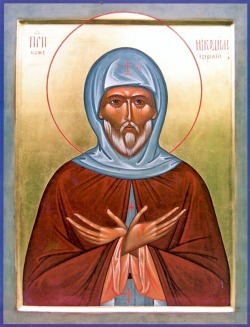
Saint Nikodim of Kozheezersk, in the world Nikita, was born in the village of Ivanovka in the Rostov district to a peasant family. In his youth, while working in the fields with his father, he heard the call to monastic life.
After the death of his parents, Nikita learned the craft of blacksmithing and moved to Moscow, where he led a modest life, helping the poor. After falling seriously ill with a stomach ailment following a meal with a friend, poisoned by his wicked wife, he was healed through the prayers of Blessed Basil.
Upon meeting the fool-for-Christ Ilya, who called him “the hermit of Khozyauga,” Nikita took this as a calling to monasticism. Selling his possessions, he went to the Chudov Monastery to the archimandrite Pafnuty and took the monastic vows, receiving the name Nikodim.
In the monastery, he was an example of humility and brotherly love. In 1602, Archimandrite Pafnuty became a metropolitan and took Nikodim with him, but he sought a life of solitude. A year later, with the blessing of the archpastor, he went north and settled in the Kozheezersk Monastery.
Desiring seclusion, he founded a cell on the river Khozyauga and spent 35 years there, emulating Saint Paul of Thebes. In silence, he offered prayers, shared fish with the brethren, and spent nights in prayer. His prayers saved from calamities, including fire and flood.
When the cell fell into disrepair, the monks built a new one, and Nikodim dug a grave for himself for prayer. He attained high spiritual gifts, including the gift of tears and continuous prayer, and was endowed with discernment and the power of healing.
Saint Alexius and Saint Dionysius appeared to him, predicting the time of his departure to the Lord, which occurred on July 3, 1640. The relics of the saint rest in the Theophany Church of the Kozheezersk Monastery. His life was written by his disciple, Hieromonk Jacob. Healings occurred at his grave and at the site of the saint's cell, and his monastic mantle and staff received healing power.
