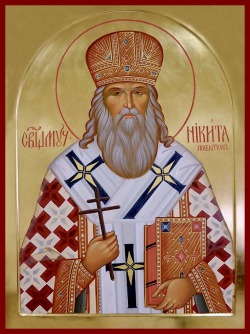
Bishop
Bishop Nikita (Pribytkov Nikolai Grigoryevich) was born on December 6, 1859, in Altai. After graduating from the Theological Seminary, he became a priest. In 1918, he accepted monastic tonsure with the name Nikita. From 1924 to 1927, he served as the Bishop of Kuznetsk, Rubtsovsk, and Biysk, a vicar of the Altai Diocese. In 1932, he was sentenced to 5 years of imprisonment. In 1934, he was released early and appointed Bishop of Mamalyzh, and from May 22, 1935, he served as Bishop of Belev, a vicar of the Tula Diocese.
As a priest, Bishop Nikita diligently cared for the observance of the Church Statute, was a zealous preacher, and performed services with reverence. Accepting monastic tonsure at an advanced age, he quickly won the love of the Belev flock. In 1922, a Orthodox Church community was established in Belev, uniting monks, clergy, and laypeople.
Despite the persecutions, the community continued to exist, uniting hundreds of people. In the early 1930s, severe persecutions against the Russian Orthodox Church began. Bishop Nikita was arrested on December 16, 1937, and accused of counter-revolutionary activities. The case contains interrogation protocols where witnesses testified that they were agitated.
On December 30, 1937, the 'troika' issued a verdict: execution by shooting. Bishop Nikita and 19 other arrested individuals were shot on January 3, 1938, and buried in the Tesnitsky forest at the 162nd kilometer of the Moscow-Simferopol highway.
