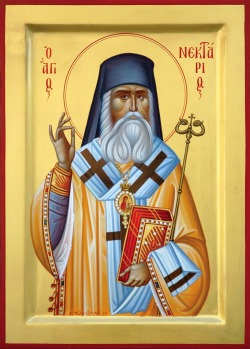
Metropolitan Bishop
Saint Nektarios of Aegina lived in the 19th and 20th centuries. He was glorified by the Greek Orthodox Church. He was born in 1846 in Selyvria, Thrace, and was given the name Anastasios. From an early age, he loved the Church and devoted himself to studying the Holy Scriptures. At the age of 14, he moved to Constantinople, where he found a job and began supporting his own education.
Life in a big city was not easy. One day, overwhelmed by despair, Anastasios wrote a letter asking God for help. In a miraculous turn of events, he received what he needed from a merchant who happened to cross his path and was moved by the depth of his faith.
At the age of 22, he moved to Chios, where he became a teacher. His moral character and virtuous life served as an inspiring example not only to his students but also to the faithful of the island. Later, he entered a monastery and took the monastic name Nektarios.
He graduated from the Theological School in Athens and was ordained a priest. He was later consecrated Bishop of Pentapolis. His virtuous and enlightened character often aroused the envy of others, eventually leading to his dismissal and removal from his duties. He accepted the punishment imposed upon him with patience and humility.
After his dismissal, he settled in Athens, where he continued his ministry and began preaching the Gospel. He soon became director of the Theological School in Athens.
Saint Nektarios founded a monastery on the island of Aegina. Throughout his life, he endured many sorrows and trials, yet he remained humble and devoted to God. He reposed on 9 November 1920. In 1961, myrrh began to emanate from his holy relics.
Saint Nektarios is venerated as the patron saint of people suffering from cancer and other serious illnesses.
