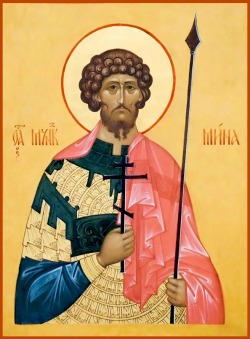
The holy martyrs suffered for their faith in Christ during the reign of Emperor Maximian (305–313). The saint was sent by the emperor from Athens to Alexandria to suppress the disturbances between Christians and pagans. Possessing the gift of eloquence, he openly began to preach the Christian faith and converted many pagans to Christ. Upon learning of this, Maximian sent the eparch Hermogenes to Alexandria to judge the saint and also ordered the city to be cleansed of Christians. Hermogenes, although a pagan, was distinguished by his piety. Struck by the saint's long-suffering during tortures and his miraculous healing after terrible torments, he himself believed in the True God. The emperor arrived in Alexandria, but neither the steadfastness of the saints during the tortures nor the miracles shown by God softened him. The emperor personally beheaded Saint Eugraphus, the secretary of the saint, and ordered the heads of the holy martyrs to be cut off.
The relics of the holy martyrs, thrown into an iron box into the sea, were later found (February 17) and transferred to Constantinople. Emperor Justinian built a church in honor of the holy martyr Mina of Alexandria. Saint Joseph the Hymnographer composed a canon in honor of the holy martyrs.
