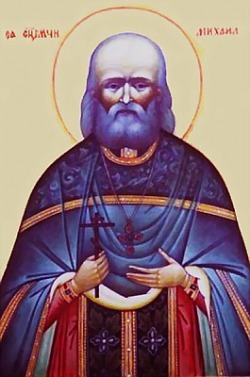
Presbyter
He was born on January 7, 1866, in the village of Sukhaya Niva, Demyansk district, Novgorod province, in the family of deacon Konstantin Dmitrievich Borisov. He graduated from the Novgorod Theological Seminary in 1888 and was appointed as a psalmist in the women's Pokrov Zverin Monastery. On September 17, 1889, he was ordained as a priest for the newly built church in the village of Kipino. He served in various churches and monasteries, actively participating in church and educational life.
In 1906, he was awarded a pectoral cross, and on July 30, 1917, he was elevated to the rank of protodeacon. He participated in religious and moral readings and the church-public life of the city. On June 6, 1917, he delivered a report on the topic 'On the Reform of the Parish,' emphasizing the importance of spiritual service and the struggle against sin.
With the onset of persecutions against the Church, he was arrested in 1926 and spent twenty days in prison. In 1931, he was evicted from his home with his family. In 1933, he was arrested along with members of the religious-labor Brotherhood, in which Bishop Makary was a member. On May 3, 1933, during interrogation, he expressed his dissatisfaction with the Soviet government and its persecutions against religion.
On May 19, 1933, he was sentenced to deprivation of the right to reside in capital cities and moved to Uglich, where he continued his ministry. On October 28, 1937, he was arrested and accused of participating in counter-revolutionary activities. On November 5, 1937, the NKVD troika sentenced him to ten years of imprisonment, but due to health reasons, he was left in the correctional labor colony in Yaroslavl.
He passed away on June 4, 1942, in the Yaroslavl correctional labor colony and was buried in an unmarked grave.
