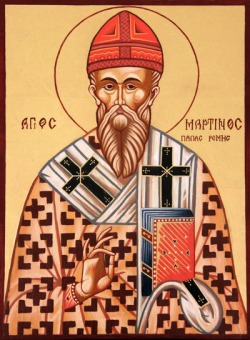
Bishop
Upon the death of Pope Theodore of Rome, Saint Martin was unanimously elected as his successor. At that time, Constans, the son of Constantine, was emperor in the East, where the heresy of the Monothelites, who claimed that Christ had only a single "will", was spreading. When Saint Martin ascended the papal throne, he rejected the heretical teaching supported by the emperor and convened a council of 105 bishops, which cursed the heresy.
The emperor, enraged, sent the military commander Olympius to arrest the pope. However, he was unable to carry out the order because of the great number of people that were gathered at the council. Later, Theodore was also sent to the pope, accusing Saint Martin of being in close relation with the Saracens and of misleading people by his false teachings. Though Saint Martin defended himself, he was nevertheless captured and sent into exile on the island of Naxos, where he endured hunger and was deprived of all necessary goods.
After a year in exile, the saint was taken to Byzantium, where he was again subjected to humiliation and imprisonment. Despite his sufferings, Saint Martin remained steadfast in spirit, unceasingly confessing his faith in Orthodoxy. His torments continued until he was sent to Cherson, where he was left to starve. Two years later he departed to the Lord.
His venerable body was buried in the church of the Most Holy Theotokos. Soon his tomb became a place of healing for the many who turned to him in prayer.
