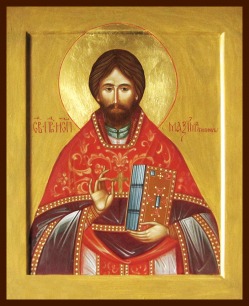
Hieromonk
He was born on June 17, 1876, in the village of Bolshoy Surmet, in the family of a Mordovian peasant, Grigory Stepanovich Popov. He was named Mephodiy at baptism. He was raised in a pious family where the church order was observed. He received his education at a church parish school. In 1900, he married Elena Timofeevna Polyakova, and they had six children.
In 1915, Grigory Stepanovich divided the family allotment among his sons. Mephodiy received land and livestock, cultivating wheat, rye, and oats. He often made pilgrimages to Orthodox shrines and was a humble and God-fearing man. In his family, reading the lives of saints and the Law of God was a common practice.
Father Luka served in the Church of Cosmodemyan, who organized the church choir. In the early 1920s, the authorities closed the church, and Mephodiy exposed a pretender who was posing as a priest. His authority among the peasants was high, and he resisted attempts by Mormons to draw him into their sect.
In 1921, a famine began in the Volga region, and in 1922, his father and wife passed away. Mephodiy, miraculously recovering, began to pray even more fervently. In 1926, Bishop Ioann tonsured him into monasticism with the name Maxim and ordained him as a hieromonk.
The monastery where he served was closed in 1927-1928, and he continued to serve in the Ilyinsky Church in the village of Ryabash. Father Maxim strictly fasted and served with zeal. In 1931, he was arrested after a holiday when he was suspected of anti-Soviet agitation. He refused to renounce God, for which he was sentenced to five years of exile in the Northern Territory.
In exile, he continued to care for his children, instructing them to live with God. In 1934, suffering from illness, he passed away in the home of a believing resident of the village of Navolochki, receiving a Christian end and burial.
