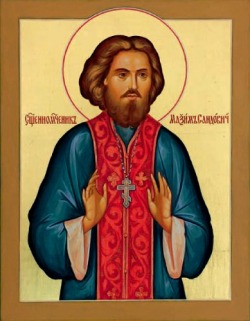
Presbyter
He was born on January 19/31, 1886, in the village of Zhdyn in Subcarpathia to a family of Lemko Uniates. His father, Timofey, was a psalmist, and his mother, Kristina, was a homemaker. After completing a four-grade school, he continued his studies at a gymnasium in Nowy Sącz. In 1904, he entered as a novice in the Pochaev Lavra, and later studied at the Volhynian Theological Seminary in Zhytomyr.
In 1911, he married Pelageya Grigoryuk, the daughter of a village priest, and was ordained a priest by Archbishop Antony (Khrapovitsky). He returned to his homeland, dedicating himself to missionary work among the Lemkos, who sought to return to Orthodoxy. His ministry began in the village of Grab, where he soon faced persecution for his activities.
On December 2, 1911, arrests began, and he was imprisoned for eight days. After his release, he continued to serve despite new arrests and persecutions. In 1914, he was arrested on charges of espionage; however, the court found him innocent, and he was released.
With the onset of World War I, arrests resumed, and on August 4, 1914, he was arrested again. He was taken into custody along with his relatives and found himself in an overcrowded prison in Gorlice. On September 6, 1914, after a decision for the death penalty, he was executed by firing squad. Before his death, he proclaimed: “Long live holy Orthodoxy! Long live Holy Rus!”
His body was buried in the Gorlice cemetery without a Christian burial. In 1922, his remains were exhumed and reburied in Zhdyn. The death of the saint led to a spontaneous return of the Lemkos to Orthodoxy. In 1994, he was canonized, and his canonization took place on September 9-10 of that year in Zhdyn and Gorlice.
