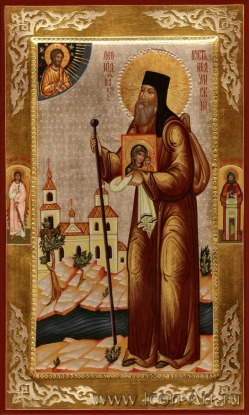
Hieromonk
Venerable Leonidas was born in 1551 in the Poshekhonye–Yaroslavl region. He grew up in the pious farming family of Philip and Catherine. Raised in the fear and love of God, he devoted the first fifty years of his life to agricultural work, a way of life that cultivated in him remarkable patience, humility and spiritual purity.
In 1603, he was granted a vision of the Most Holy Theotokos, who instructed him to transfer her icon of Hodegetria to the banks of the Luza River. At first, the saint found it difficult to accept the vision as a divine revelation. However, before long, he resolved to leave behind his life as a farmer and entered the Kozheozersky Monastery, where he was tonsured a monk.
After three years of monastic life, he received a second vision of the Mother of God. Having obtained the blessing of Abbot Anthony, he departed for the Morzhevsk Hermitage, where he spent a year in obedience before deciding to fulfill the command he had received.
There, he continued his life of prayer and rigorous labor. Following a fourth vision, the exact location for the transfer of the icon was revealed to him. With the appropriate blessing, he traveled to the Luza River and settled there.
He built a small cell and began working tirelessly to establish a monastery. Inspired by his piety and ascetic way of life, the local people gradually gathered around him. Before long they built a small chapel.
In 1608, at the request of the faithful, Leonidas traveled to Metropolitan Philaret of Rostov to seek his blessing for the construction of a permanent church. The metropolitan granted his request and ordained him as a hieromonk.
The church, dedicated to the Presentation of the Most Holy Theotokos, was consecrated on 17 February 1608. From that time onward, numerous healings and miracles were reported there. At the same time, Venerable Leonidas lovingly cared for the brethren and guided them in the Orthodox faith.
Among his many spiritual gifts, there was that of prophecy. He foretold the future of the monastery and spent long hours in prayer on the shores of Black Lake.
Venerable Leonidas reposed in the Lord on 17 July 1654. His holy relics were placed in the church of Ust-Nedum, where his monastic tunic was also preserved for many years as a testimony to his ascetic life and spiritual struggles.
