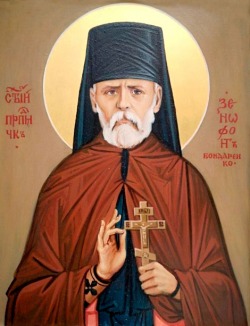
Hieromonk
Saint Ksenofont (in the world Konstantin Andreevich Bondarenko) was born on May 13, 1886, in the village of Nikitovka, Valuysky district of Voronezh province, into a peasant family. After finishing the Kopano-Nikitovskoye folk school, he helped his father with the household. On January 21, 1910, he entered the Trinity-Sergius Lavra, where on June 15, 1916, he was tonsured into the mantle with the name Ksenofont. In 1918, he was ordained as hierodeacon, and in 1926 – as hieromonk.
After the closure of the Lavra in 1919, he remained there as a locksmith. In 1924, he moved to Petrograd, worked as a mechanic, and then returned to Moscow, where he served in churches. In 1932, he served in the church of the village of Mikhailovskoye in the Zvenigorod district. In 1935, he was arrested and imprisoned in Butyrka prison on charges of anti-Soviet agitation.
On March 21, 1935, the investigation was completed, and hieromonk Ksenofont was accused of systematic anti-Soviet agitation among the peasants. On March 31, 1935, the Special Meeting of the NKVD sentenced him to three years of imprisonment in a correctional labor camp. He was sent to Temlag, where he spent all his time in confinement.
In August 1937, he returned from the camp and settled in the city of Alexandrov, Vladimir region. At this time, the persecution of the Russian Orthodox Church began. On September 19, 1937, he visited Archimandrite Kronid, after which he was arrested on November 20, 1937, and imprisoned in Taganka prison.
On December 7, 1937, the NKVD troika sentenced him to execution by shooting. Hieromonk Ksenofont was shot on December 10, 1937, and buried in an unmarked common grave at the Butovo firing range near Moscow.
