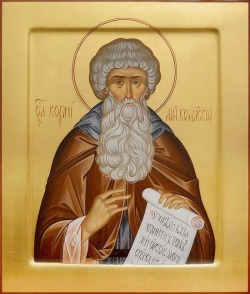
Saint Cornelius of Komel, born in 1457 in a noble boyar family of the Kryukovs in Rostov the Great. From a young age, he was raised at the court of Grand Duchess Maria, where he acquired education and purity of heart. Under the influence of his uncle, Deacon Lukian, he chose the path of monasticism and took the monastic vows in the Belozersky Monastery, following his spiritual mentor, Elder Gennady.
Cornelius began his monastic struggles with heavy obedience, but soon, striving for higher perfection, he visited many monasteries, gathering spiritual benefit. In Novgorod, Archbishop Gennady wanted to ordain him to the priesthood, but he declined this honor, preferring a life of solitude. He lived in the wilderness, enduring many hardships for Christ.
In 1497, finding an abandoned hut in the Komel forests, he began a life in complete solitude. His prayers and the grace of God led to the conversion of bandits who inhabited those places. At the age of forty, he was able to live in perfect seclusion, and soon, lovers of silence began to come to him, prompting him to build a church.
In 1501, a wooden church was built in honor of the Entry of the Most Holy Theotokos into the Temple, and Cornelius was ordained to the rank of hieromonk. He worked for the good of the brotherhood, built a stone church, and composed a rule for the monastery, which became the third rule written by a Russian saint for monks.
The rule included 15 chapters containing instructions for the monks. It required strict adherence to church piety and prescribed that the monks live in peace and harmony. However, the strict rule caused discontent among the brotherhood, leading to turmoil.
Cornelius left the monastery to avoid conflicts and founded a new monastery in the Kostroma forests. Despite attempts to bring him back, he remained steadfast. Later, after a pilgrimage, he returned to the Komel Monastery, passing the leadership to his disciple Lavrenty.
In 1537, sensing the approach of his end, he gathered the brotherhood and left them instructions on observing the rule. He died on May 19, 1537, at the age of 82. His body was buried near the Vvedensky Church, and later his relics were glorified by miracles.
The life of Cornelius was a service to God and his neighbors, and he raised many holy disciples. The church-wide celebration for him is established on May 19/June 1. His life was composed by his disciple Naphthali in 1589.
