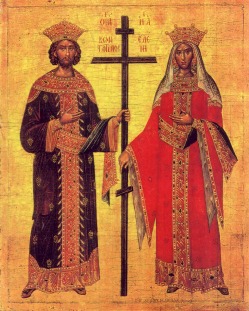
During the 3rd and 4th centuries, idolatry was spread all over and Christians were persecuted with great hatred. In His providence, God sent a protector and defender of the Church: Saint Constantine, Equal to the Apostles. The saint was born in 274 and, despite the pagan environment in which he was raised, he sought from childhood to know the true God. His father, Constantius Chlorus, secretly rejected paganism and honored the one and only God, something that deeply influenced the upbringing of the young child.
As he grew older, he entered the court of Diocletian, where he witnessed the fierce persecutions against Christians. What he saw strengthened his faith and his desire to serve Christ. After the death of his father, he was proclaimed emperor. One of his first acts was to proclaim freedom of Christian worship.
Even before he was baptized, Constantine began to support Christians in practical ways. When he beheld in a vision a cross with the inscription “In this sign conquer,” he decided to confess his faith openly. In 312, he confronted the tyrant Maxentius, who persecuted Christians. Constantine triumphed, while his entrance into Rome became an event of victory and glory in the name of the Triune God.
As emperor of the entire Roman Empire, he issued the Edict of Toleration, abolished pagan sacrifices, and restored the Christian temples. He relieved the clergy of taxation and returned the properties that had been taken from them during the persecutions.
His reign was marked by peace and prosperity. Yet Licinius continued to persecute Christians in the East. Once Constantine became sole ruler, he defended them and extended their rights throughout the whole empire. Thus, Christianity was spread everywhere.
Saint Constantine founded a new city, which became the capital of the empire. In the newly named Constantinople, no pagan temples were permitted. Instead, numerous churches were built, dedicated to the one true God. He cared for the welfare of the clergy and all the faithful, becoming one of the greatest protectors of Christianity.
