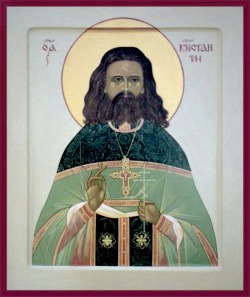
Presbyter
Saint Constantine was born on May 7, 1867, in the family of priest Ioann Petrovich Sukhov in the village of Zhemkovka, Syzran district of the Simbirsk province. He studied at the Simbirsk Theological Seminary and graduated with a full course of theological sciences on July 18, 1887. After being ordained as a deacon and priest, he served in various villages, including Yasashnaya Tashla and Opalikh. In 1890, he was accepted into the clergy of the Samara diocese and served in the village of Staro-Dvoryanka, and later in Tsarevshchina, where he earned the love of the parishioners and was the head of the church-parish school. In 1900, he returned to Tsarevshchina at the request of the parishioners after a temporary transfer to Uzmore.
In 1903, he moved to Buguruslan, where he became the rector of the Spaso-Ascension Cathedral and actively participated in the zemstvo assembly, striving to improve the living conditions for the peasants. His efforts to enlighten the people and improve healthcare incited hatred from the Bolsheviks. On February 25, 1918, he led a Cross Procession, protesting against lawlessness. In October 1918, he was arrested and shot on the banks of the Kinel River, where he had previously performed Epiphany services. His body was secretly buried, and the burial site remains unknown.
On July 17, 2001, he was glorified in the ranks of the saints of the new martyrs and confessors of Russia. His memory is celebrated on October 9 (22) and on the day of the Assembly of the New Martyrs and Confessors of Russia.
