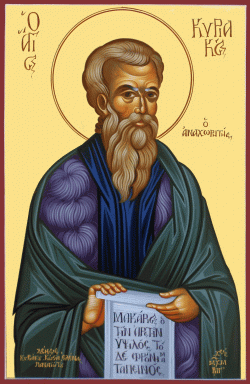
He came from Corinth, being the son of presbyter John and mother Eudoxia. He was born in the last years of the reign of Theodosius the Younger. In his youth, he became a reader in the cathedral church, studied the Holy Scriptures, and aspired to imitate the servants of God. At the age of eighteen, hearing the words of the Gospel about following Christ, he left home and went to Palestine.
He arrived in Jerusalem, where he met the man of God Eustorgius and spent the winter in his monastery. Seeing the labors of the monks, he began to strive for the monastic life. Then, wishing to live in the desert, he asked Eustorgius to send him to the venerable Euphemios, who tonsured him as a monk and sent him to Saint Gerasimos.
In the monastery of Saint Gerasimos, he showed diligence in labors and prayers, fasted strictly, worked in the kitchen and in other obediences. After the death of Euphemios, he returned to the lavra, where he lived in solitude and befriended the monk Thomas. After parting with his friend, he imposed a vow of silence upon himself and lived in his cell for ten years.
He moved to the Sukiy monastery, where he served in various obediences and was appointed presbyter. At the age of seventy, he withdrew to the Natuv desert, where he lived with a disciple, feeding on bitter herbs, which God changed into sweetness. He performed miracles, healed the sick, and cast out demons.
After famine and plague, at the request of the brethren, he returned to the Sukiy monastery, where he fought against the heresy of Origen. He predicted the imminent death of the heretics and continued to live in silence. At the age of one hundred and nine, having called the brethren, he left a teaching and, after praying, surrendered his soul to the Lord.
He was buried with honors, and the brethren mourned for him, glorifying God for his labors.
