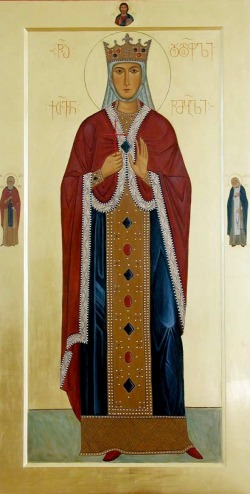
Saint Ketevana the Great Martyr came from the royal family of Bagrationi and was the great-granddaughter of the King of Kartli, Constantine. After becoming the wife of David, she ruled the kingdom herself, demonstrating deep piety and concern for the needs of the Georgian Church, building churches and shelters. After her husband's death, Saint Ketevana settled in solitude.
Her husband's brother, Constantine, having accepted Islam, killed King Alexander II and his brother George, after which the queen mourned them and buried them in the Alaverdi Cathedral. Constantine, wishing to marry her, was defeated in battle, and under the wise rule of the queen, peace and justice reigned in Kakheti.
Shah Abbas I returned her son Teymuraz, who, although living at court as a hostage, preserved the Orthodox faith. Later, wishing to save her people, Saint Ketevana went to Isfahan, where she refused to accept Islam and was thrown into prison for ten years, enduring cruel torture.
She steadfastly bore her sufferings, not yielding to persuasion and threats, and on September 13, 1624, she surrendered her soul to God. Three bright pillars descended upon her body, signifying her spiritual victory. The relics of the saint were transferred to Rome, and parts of the relics were given to King Teymuraz I and placed under the altar of the Alaverdi Cathedral.
Catholicos-Patriarch Zachariah canonized her, establishing her feast day on September 13.
