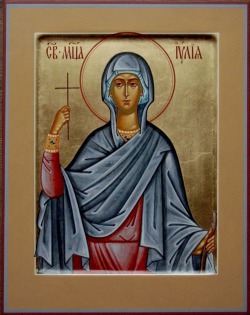
The Holy Martyr Julia was born in Carthage during the fifth century into a Christian family. While still young, she was taken captive by the Persians and sold into slavery in Syria. Remaining steadfast in the teachings of Christ, she faithfully served her master, preserving her purity, observing every fast and offering continual prayer to the Lord.
Although her master repeatedly tried to persuade her to abandon her faith, Julia steadfastly refused to renounce Christ and embrace paganism. On one occasion, when her master traveled to Gaul for business, he took her with him. Upon arriving on the island of Corsica, he participated in a pagan festival while Julia remained aboard the ship. After intoxicating the merchant, as well as his companions, the people of the island came to Julia and demanded that she offer sacrifice to their gods. Fearlessly, she confessed that she was a Christian. As a result, the pagans condemned her to death by crucifixion.
After her martyrdom, an Angel of the Lord appeared to the monks of the monastery of the neighboring island and revealed to them what had taken place. The monks recovered her body and buried it in the monastery church.
Around the year 763, the holy relics of Saint Julia were translated to the women's monastery in the city of Brescia.
