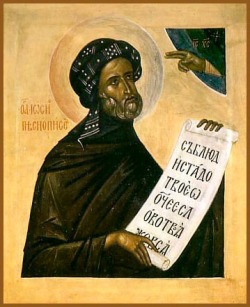
Presbyter
He was born in Sicily to a pious family. From a young age, he exhibited virtues: he was meek, humble, and loved fasting. After the invasion of the barbarians, he fled with his parents to Peloponnesus, and then to Thessalonica, where he was tonsured a monk and became a perfect ascetic. He accepted the priesthood and became a presbyter, diligently praying and celebrating the liturgies.
With Saint Gregory of Decapolis, he walked around the city, strengthening the faithful in the true faith during the persecutions against the Church. At Gregory's request, he went to Rome to report on the persecutions. However, he was captured by robbers and imprisoned on Crete, where he comforted other prisoners.
He spent six years in captivity until he learned of the death of King Leo the Armenian. Saint Nicholas appeared to him and freed him from prison. Upon returning to Constantinople, he founded a monastery and built a church in honor of Saint Nicholas. He received a part of the relics of Saint Apostle Bartholomew and began to write church hymns that adorned the feasts of the saints.
Under King Theophilus, he again faced persecution for denouncing heresy and was exiled to Cherson. After the restoration of Orthodoxy, he returned to Constantinople, where he became the keeper of the treasures of the Church of Constantinople. He denounced injustices, for which he suffered exile again. After the death of Varda and King Michael, he returned to his former position.
He reached a great old age, fell ill, and predicted his imminent departure. On Great Friday, he rewrote church documents and, having received communion, peacefully surrendered his soul to God. Many people came to his funeral, calling him father and teacher. His soul was taken to heaven with honors, and he became an ornament of the Church, singing the glory of the Trinity.
