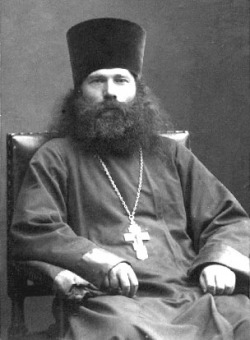
Presbyter
Saint John was born on January 5, 1879, in the village of Preobrazhenskoe, Serpukhov district, Moscow province. In 1901, he graduated from the Moscow Theological Seminary and was appointed as a law teacher in a parish school. In 1905, he was ordained as a priest. He served in various church and public positions, including being the head of the parish school and the chairman of the Brotherhood of Sobriety. In 1919, he was awarded a pectoral cross, and in 1921, he was elevated to the rank of protopresbyter. In 1922, he was appointed as the rector of the Nikolskaya Church. In 1930, he was arrested for 'anti-Soviet activities' and sentenced to three years of exile. Upon his return in 1934, he was appointed as the rector of the Nikolsky Church in the village of Vyshelets. On November 27, 1937, he was arrested again and accused of conducting anti-Soviet activities. On December 5, 1937, the NKVD troika sentenced him to execution, which was carried out on December 9. He was buried in an unmarked grave at the Butovo firing range near Moscow.
His wife, Maria Fedorovna, devoted herself entirely to church life after his arrest, attending the church and singing in the choir. She and her daughter Antonina with her son lived in a hut, trying to learn about the fate of the priest, but unsuccessfully. The churches in the village of Vyshelets were destroyed, and one of them burned down.
