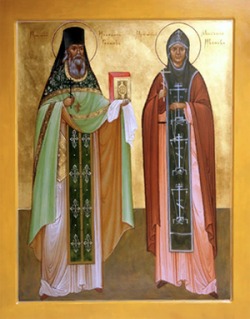
Hieromonk
Saint Ilarion (in the world Ivan Andreevich Gromov) was born in 1864 in the village of Krupshево, Tver Province, into a peasant family. In 1914, he was transferred to the Athonite Monastery's dependency in Moscow, where he took monastic vows under the name Ilarion and was ordained as a hieromonk.
From 1922, due to the persecution of the Russian Orthodox Church, Ilarion began serving as a non-staff priest at the Church of Gregory of Neocaesarea in Moscow. On January 17, 1931, he was summoned to the OGPU for interrogation, where he stated that he did not agitate against the Soviet government and believed that all authority is given by God.
On January 29, 1931, Ilarion was prepared for exile along with other clergymen. On February 8 of the same year, he was sentenced to three years of exile; half of the arrested were sent to Kazakhstan, while Ilarion was sent to the Northern region for the construction of a railway line. The living conditions were extremely harsh, and many clergymen died from diseases and unbearable labor.
In 1934, after completing his sentence, Ilarion returned to Moscow, but he was denied a passport. He moved to Vladimir, where he obtained documents and settled with his spiritual son in the city of Petushki. In 1937, he was hit by a tram, after which he lived with various spiritual children, as staying in one place was dangerous.
On August 26, 1937, Ilarion was arrested and imprisoned in Butyrka prison. By October 5, 1937, the investigation was completed, and he was accused of participating in counter-revolutionary activities. On October 8, the NKVD troika sentenced him to death by shooting. Saint Ilarion was executed on October 11, 1937, and buried in an unknown common grave at the Butovo firing range near Moscow.
