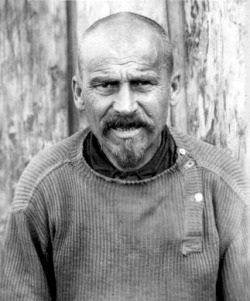
Ηegumen / Abbot
He was born on January 20, 1883, in the village of Pochinki, Kashin district, Tver province, in the family of peasant Ioann Vorobyev and his wife Pelageya Egorovna. He graduated from three classes of a church parish school and one-year medical courses for feldshers.
In 1909, he entered the Alexander-Svirsky Monastery, where he was tonsured and ordained as a hieromonk. From 1915 to 1918, he was at the front, combining his service as an army priest with the position of a pharmacist in the Red Cross. After returning home in 1918, he helped his family with farming, and in 1919, he was drafted into the Red Army, serving as a company feldsher until August 1921. After demobilization, he worked in agriculture, and in 1923, he returned to the priesthood.
From 1924, he served as a priest in the church of the village of Koprino, Mologsky district, Yaroslavl region. Presumably in 1931, he was elevated to the rank of igumen. On October 14, 1936, he was arrested for "counter-revolutionary remarks against Soviet power and anti-collective farm agitation." On February 28, 1937, he was sentenced to seven years of imprisonment and deprived of electoral rights for five years.
On March 3, 1937, while in the Yaroslavl regional prison, he sent a cassation appeal, in which he denied his guilt. The Supreme Court rejected the appeal. Initially, he served his sentence in the Uglich district of Yaroslavl region, and on May 13, 1937, he arrived at the Volga camp.
In the fall of 1937, mass repressions against clergymen began. Based on false witness testimonies, he was accused of "counter-revolutionary agitation." On October 28, 1937, the troika of the U.N.K.V.D. of the Yaroslavl region sentenced him to death by shooting. On November 4, 1937, on the day of the Kazan Icon of the Mother of God, the sentence was carried out. The place of the martyr's death and burial of the saint is not indicated in the case materials, but it is known that in 1937, mass shootings of prisoners occurred in the forest near the village of Shikhany.
On July 31, 1989, he was rehabilitated. On August 20, 2000, after the completion of the Jubilee Archpastoral Council of the Russian Orthodox Church, he was canonized among the new martyrs and confessors of Russia.
