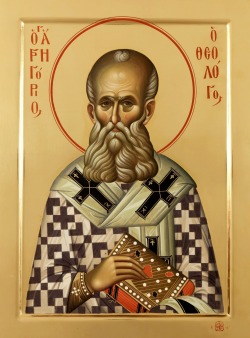
Archbishop
Saint Gregory the Theologian (326-389 AD) was the son of Gregory, the bishop of Nazianzus, and Nonna, a woman of high moral standards. His mother dedicated him to God even before his birth. Having received an excellent education, he studied in Caesarea, Alexandria, and Athens, where he became close to Saint Basil the Great. At the age of 26, he accepted Baptism.
After returning to his homeland, Saint Gregory long avoided public activity, preferring prayer and service to his parents. Soon he was ordained as a presbyter, and then, by a secret agreement with Basil the Great, he became the bishop of the city of Sasima, but he refused the position, continuing to serve his father and the flock in Nazianzus.
After the death of his parents, Saint Gregory managed the church for some time, but then withdrew into solitude. However, he was soon elected Archbishop of Constantinople during the reign of the Arians. He began to preach despite persecution and attracted many people to Orthodoxy.
After the ascension of Emperor Theodosius, the Arians were expelled from the churches. Saint Gregory fought against the heresy of Macedonius and participated in the Second Ecumenical Council. After completing his labors, he renounced his see and withdrew to his native village of Arianz, where he spent his last years in ascetic feats.
For his theological works, Saint Gregory received the honorary title of Theologian and teacher of the whole Church. His sermons were distinguished by a poetic style, and many phrases from them were used in church hymns. The incorrupt relics of his body continue to emit a fragrance.
In Constantinople, disputes arose over the preference between the three saints: Basil, Gregory, and John Chrysostom. In 1084, the saints appeared to the Metropolitan of Euchaïta, John, commanding him to cease the disputes and establish a common day of celebration for their memory.
