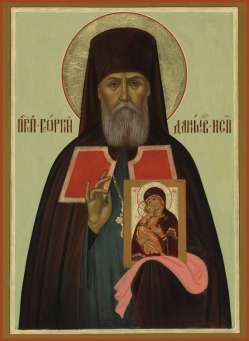
Archimandrite
Saint George, archimandrite, was born on February 28, 1868, in the Yelets district of the Oryol province in a pious peasant family. At the age of 12, he visited Optina Monastery, where Elder Ambrose blessed him to stay there. From 1898, he became a novice at the Vvedenskaya Optina Monastery, was tonsured in 1899 with the name George, and was ordained a hieromonk in 1902. From 1915 to 1918, he was the abbot of the Georgievsky Monastery in Meshchovsk, Kaluga province.
After the monastery was closed in December 1918, Father George was accused of "secret conspiracy" and "possessing weapons." He was arrested and sent to prison in Kaluga, where, thanks to a miraculous vision, he comforted other prisoners. In 1919, an amnesty was issued, and the death penalty was replaced by five years of imprisonment.
Until 1921, he was in solitary confinement, underwent surgeries, and became a sanitary worker, which allowed him to hear confessions and administer communion to the inmates. In Taganka prison, he received a blessing for eldership from Metropolitan Cyril. After his release, he served in the Holy Danilov Monastery, where people came to him for spiritual consolation.
In May 1928, he was arrested for the second time and sentenced to three years of exile in Kara-Tyube, Ural region, where he lived under harsh conditions and fell ill with throat cancer. After his release, he settled in Nizhny Novgorod. On June 21, 1932, after receiving communion, he passed away and was buried at the Bugrovsky cemetery.
In October 2000, the holy relics of the elder were discovered and transferred to the Holy Danilov Monastery in Moscow. Saint George was canonized among the New Martyrs and Confessors of Russia in August 2000 for public veneration.
