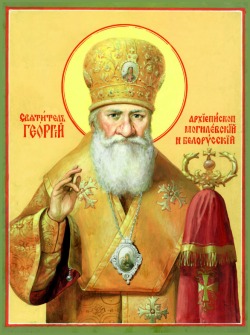
Archbishop
Born in 1717 in Nizhyn to a family of Ukrainian nobility, the Konetsky family. He studied at the Kyiv-Mohyla Academy, graduating with "special distinction." He studied various foreign languages, poetics, philosophy, and theology, demonstrating a particular talent for poetry. After completing the academy, he took monastic vows under the name George and became a rhetoric teacher.
From 1747, he headed the philosophy department and served as prefect, and from 1751, he became the rector of the academy and a professor of theology. In 1752, he was appointed archimandrite of the Kyiv-Bratsky Monastery. In 1755, he became the Bishop of Belarus and moved to the city of Mogilev, and from 1783, he served as the Orthodox Archbishop of Belarus.
At that time, there was only one Orthodox diocese remaining in Belarus, centered in Mogilev. Archbishop George, recognizing the decline of the Orthodox Church, wrote numerous reports about the oppression of Orthodox believers. He cared for the spread of Orthodox teaching, opened a printing house, and published the Orthodox "Catechism." He also founded several schools and a theological seminary at the Spassky Monastery.
George was concerned about the well-being of his diocese, built a new building for the seminary, and collected archival documents about Orthodox churches. He issued decrees against the wrongful actions of priests and the disbelief propagated by Voltaire.
He died on February 13, 1795. He was buried in Mogilev in the Church of the Transfiguration of the Savior. His remains became known for their incorruption. The memory of Saint George began to be honored shortly after his death, and in 1904, a memorial service was established. In 1993, he was canonized and added to the Assembly of Belarusian Saints. On November 30, 2017, a decision was made for his canonization throughout Russia, with the celebration of his memory established on August 6 according to the new calendar.
