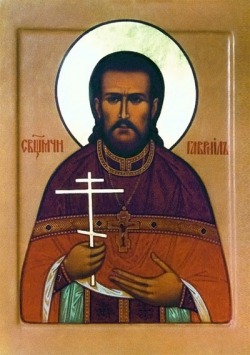
Presbyter
Saint Gabriel was born in 1871 in the city of Mikhailov, Ryazan province, in the family of a blacksmith, Mikhail and Olga. He graduated from school and became a blacksmith, and from 1893 to 1896 he served in the 171st regiment, participating in the Russo-Japanese War, where he was awarded the George Cross. After military service, he worked as a blacksmith and married Tatyana Ivanovna, with whom he had eleven children. In 1920, he was elected the city head.
In the early 1920s, his eyesight deteriorated, and he decided to become a priest. In 1924, he was ordained as a deacon, and in 1925 — as a priest. His service in the church attracted parishioners, and he was respected in the village.
On March 11, 1931, Father Gabriel was arrested by the OGPU. He was accused of belonging to the clergy and serving the Church. On April 25, 1931, the OGPU Troika sentenced him to imprisonment in a labor camp for five years. In 1936, he returned from exile, but his home was destroyed. He served in the Church of the Transfiguration of the Lord in the village of Vnukovo.
On October 6, 1937, Father Gabriel was arrested again, accused of anti-Soviet agitation. On November 12, 1937, the NKVD Troika sentenced him to execution. He was shot on November 18, 1937, and buried in an unmarked grave. He was canonized among the ranks of the New Martyrs and Confessors of Russia in August 2000.
