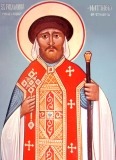
Bishop
The Holy Apostle and Evangelist Matthew, also known as Levi, preached in Syria, Media, Persia, and Parthia, completing his labors with a martyr's death in Ethiopia. He converted several idolaters to faith in Christ, established the Church, and built a temple in the city of Mirmen, appointing his companion Platon as bishop there.
During his prayer for the conversion of the Ethiopians, the Lord Himself appeared to him, giving him a staff that was to become a source of water and a tree bearing fruit. Saint Matthew healed the possessed woman and the son of the ruler Fulvian, which led to the conversion of many pagans. However, the ruler, unwilling for his subjects to become Christians, accused the apostle of sorcery and ordered his execution.
Saint Matthew was laid face down, covered with brushwood, and set on fire. But the fire did not harm him. After this, Fulvian ordered more brushwood to be added and to pour pitch over him, but the flames melted the idols and scorched the ruler himself. Terrified, Fulvian turned to the saint, asking for mercy, and by the martyr's prayer, the fire subsided. The body of the saint remained unharmed, and he departed to the Lord.
Fulvian, repenting, ordered the body of the saint to be placed in an iron coffin and thrown into the sea, promising to worship the One True God if the body was preserved. That very night, Saint Matthew appeared to Bishop Platon, commanding him to find his body on the seashore. Together with the bishop, Fulvian came. The coffin was brought ashore by the waves and honorably transferred to the temple.
Fulvian asked for forgiveness from Saint Matthew and was baptized with the name Matthew. Soon he renounced his power and became a presbyter. After the death of Bishop Platon, Saint Matthew appeared to him and called him to lead the Ethiopian Church, which he did, continuing the work of his heavenly patron.
