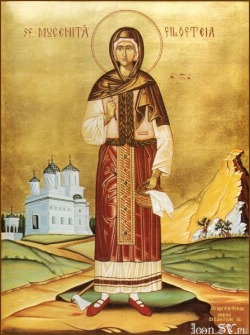
She was born in Târnovo, possibly around the year 1206. Her father was a Bulgarian farmer, and her mother was a Wallachian. Her mother raised her in the Christian spirit, but soon passed away. Her father remarried, and Philothea suffered greatly from her stepmother, who blamed her for disobedience and extravagance. Despite this, she maintained her purity, continued to attend church, and helped the poor.
The Lord called her to Himself when Philothea was twelve years old. Her father, noticing a shortage of food, decided to follow his daughter and saw her giving food to the poor. In anger, he threw an axe at her, and Philothea, mortally wounded, surrendered her spirit into the hands of Christ.
After this, her father, filled with fear and remorse, could not lift his daughter's body. He confessed to the Archbishop of Târnovo, and together with the people, they tried to carry her body, but it remained heavy. The Archbishop and the clergy prayed, and only when the monastery of Curtea de Argeș was mentioned did the body become light and was placed in a coffin.
The Archbishop wrote to the Voivode Radu the Black, asking him to accept the relics of the saint for the protection of the people. The relics were brought to the Curtea de Argeș Monastery, where they rest to this day.
Saint Philothea is venerated by the entire Romanian Orthodox Church, especially in the Argeș, Dâmbovița, and Prahova regions. People turn to her in prayers for the healing of the sick, and pilgrimages are organized, especially on December 7. During droughts, the coffin with the saint's relics was carried through the villages, and by her prayers, God sent rain.
