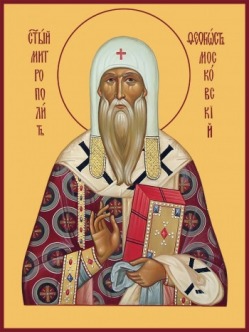
Metropolitan Bishop
Saint Theognostus, the successor of Metropolitan Peter, was born in Constantinople. He was highly educated and was regarded as an expert in ecclesiastical canons. He chose Moscow as his place of residence, offering his support to the princes of Russia.
He endured many hardships, witnessing numerous churches in Pskov being closed because of the wrath of Khan Uzbek. He also witnessed the execution of Prince Alexander of Tver, as well as of his son Theodore. Honoring their memory, he celebrated a memorial service for them and sent their bodies to Tver.
In 1342, Khan Jani Beg attempted to annul the rights of the Orthodox clergy. However, the metropolitan refused to collect taxes from the priests, invoking the words of the Apostle Paul. As a result, he was subjected to terrible torture. Seeing the saint’s steadfast faith, the Khan restored the rights of the Orthodox Church.
After returning to Moscow, the metropolitan was called upon to confront, among other challenges, a devastating fire. Nevertheless, with patience and faith, he gradually began restoring the churches of the region.
Having foretold the end of his earthly life, he appointed Bishop Alexy of Vladimir as his successor. During the final year of his life, he also met a young hermit who came to live near him. His name was Bartholomew, the future Saint Sergius. He received Saint Theognostus’ blessing to establish a church dedicated to the Holy Trinity.
The saint fell ill in 1352 and reposed on March 14, 1353. He was buried in the Cathedral of the Dormition.
In 1471, his relics were discovered to be incorrupt. In 1474 miraculous healings began to occur through his grace. In particular, a mute man was the first to be healed, claiming that he saw the saint rise from his tomb and bless his tongue.
He was officially glorified as a saint in the 19th century.
