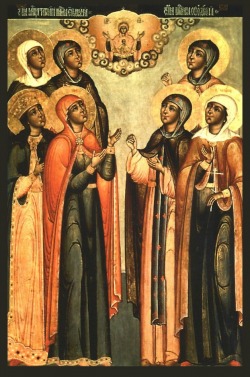
The holy martyr Theodotus and the seven martyrs – Tekusa, Faina, Claudia, Matrona, Julia, Alexandra, and Euphrasia – lived in the second half of the 3rd century in the city of Ancyra, in the Galatian region, and suffered martyrdom for Christ in the early 4th century. Theodotus, being an innkeeper and married, achieved high spiritual perfection, maintaining purity and chastity, cultivating self-restraint, and exercising in fasting and prayer. He led many to the Christian faith and healed the sick.
During the persecutions of Emperor Diocletian against Christians in Ancyra, the governor Theotecn, known for his cruelty, forced Christians to offer sacrifices to idols, threatening them with torture and death. Saint Theodotus sheltered Christians, helped them, and supported the churches in difficult times. He predicted his martyrdom, giving his ring to the priest Fronton.
The seven holy maidens, among whom the eldest Tekusa was Theodotus's aunt, boldly confessed their faith and were subjected to tortures, yet remained steadfast. They were drowned in a lake, and Tekusa appeared to Theodotus in a dream, asking him to bury their bodies. Theodotus, with the Christians, secretly retrieved their bodies and buried them.
After the bodies of the holy martyrs were taken, the governor became furious and began to persecute Christians. Theodotus was captured and, refusing to renounce Christ, was subjected to tortures. He was executed, but his body was not burned due to a storm. The priest Fronton, passing by, learned of Theodotus's body and, with the help of soldiers, buried him at the place indicated by the saint.
Saint Theodotus accepted death for Christ on June 7, 303 or 304, and his memory is celebrated on May 18, the day of the death of the holy maidens. The account of the life and martyrdom of Saint Theodotus was composed by Nylus, a contemporary and eyewitness of his death.
