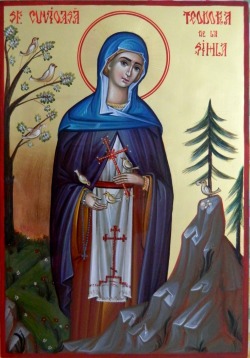
Saint Righteous Theodora was born in the mid-17th century in the village of Vynetory in a family of devout Christians. Her father, Stefan Joldya Armas, was an armash, and her mother was engaged in raising daughters. Theodora was betrothed against her will to a young man from Izmail, but having no children, she decided to take monastic vows. She took the veil in the skete of Vârzărești, and her husband became a monk in the skete of Poiana Mărului.
After the devastating raid of the Turks on the surroundings of Buzău, Theodora took refuge in the Vrancea mountains with her spiritual mentor, Schema-nun Paisia. After the death of her mentor, she went to the Neamț region, where she continued her ascetic life in the vicinity of the Sihăstria Monastery and the Sihla Skete. The abbot of the monastery blessed her to live in the forests of Sihla, where she labored in fasting and prayer.
Theodora lived in solitude, feeding on wild berries and nuts, and acquired the gift of fervent prayer and miracles. When the Turks invaded again, she took refuge in a cave, where a miracle occurred: the rock split, protecting her from the enemies. From time to time, birds brought her food, and she found water in a hollow of the rock.
As she approached the end of her life, Theodora prayed to God for a priest to administer communion to her. The abbot of Sihăstria, noticing that birds were carrying bread, sent monks who found the saint in prayer. She asked them for clothing and a priest, and after confession, she received the Holy Mysteries, surrendering her soul to the Lord. Her body was buried in the cave.
In 1830, the relics of the saint were transferred to a precious shrine in the skete church, and then to a new church in the village of Miclăușeni. In 1856, the relics were transferred to the Kyiv-Pechersk Lavra, where the saint is called Theodora of the Carpathians. On June 20, 1992, she was canonized by the Romanian Orthodox Church, and on March 7, 2018, her name was included in the calendar of the Russian Orthodox Church.
