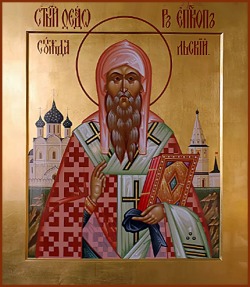
Bishop
Saint Theodore, Bishop of Suzdal, was of Greek descent and arrived in Kievan Rus from Constantinople in the retinue of Metropolitan Michael, who baptized Prince Vladimir in 987. After the baptism of the people of Kiev in 988, Vladimir, along with his sons and Metropolitan Michael, spread Christianity by appointing bishops in Russian cities. In 990, Theodore was ordained as a bishop and appointed to the see in Rostov the Great.
He began the construction of the first church in Rostov, consecrated in honor of the Most Holy Theotokos. However, the pagans in Rostov met him with hostility, and in 992 he was forced to leave the city. The saint settled in Suzdal, where he began to enlighten the people, destroying idol shrines and building churches. His gentle nature and teachings led many to embrace the Christian faith.
Theodore passed away in Suzdal, but the exact date of his death is unknown; according to some sources, it may have occurred no later than 1023. His glorification took place before the invasion of Khan Batu, that is, before 1237. In 1754, Bishop Porphyrius proposed to examine the relics of Theodore, but the Synod decided not to conduct the examination.
In 1794, the relics of the saint were placed in a coffin and have since rested in the Suzdal Cathedral. Above the relics, there is a wall inscription indicating the enlightenment of the Suzdal land by the holy Baptism. In the 20th century, the cathedral was closed, but in 1991, services began again. Currently, the relics of the saint rest in the Kazan Church on the Trading Square of Suzdal.
The service to Saint Theodore and his life were written by the monk Gregory, who labored in the Suzdal Euphymius Monastery.
